
9 minutes reading time
(1850 words)
One Transaction Should Not Be Managed in Six Different Places

In the previous edition, I argued that the property transaction should begin when the seller decides to move, not when a buyer is already waiting. Early preparation gives the seller time to complete the essential information, gather supporting evidence and involve their solicitor before the transaction comes under pressure. It allows the estate agent to market the property with greater confidence and gives avoidable problems a chance to be identified sooner. That preparation is only valuable if it remains connected to what happens next.
Once a buyer has been found, the buyer, seller, estate agents, solicitors and mortgage broker must all begin contributing. Each has a different responsibility, but they are working on the same move. The problem is that they rarely work from the same place.
The transaction is constantly being reconstructed
The seller has information in one portal. The estate agent works from a CRM. Each solicitor has their own case management system. The mortgage broker uses another platform, while the buyer receives occasional updates by email or telephone. These systems may serve each individual business, but they do not create a shared view of the transaction.
When someone asks what is happening, the answer often has to be reconstructed from several different sources. The agent calls the solicitors. The solicitors search their files. The broker checks the mortgage application. The buyer and seller compare what they have each been told. Every person may hold accurate information, but nobody can see the complete position.
This is why property transactions generate so much chasing. Work may be taking place, but progress is difficult to see. Silence is interpreted as inactivity, uncertainty creates anxiety and professionals are repeatedly interrupted because there is no dependable place to check what has moved forward. A transaction involving several parties will always require communication. It should not require everyone to rebuild the complete picture whenever an update is requested.
The complaints reveal the consequences
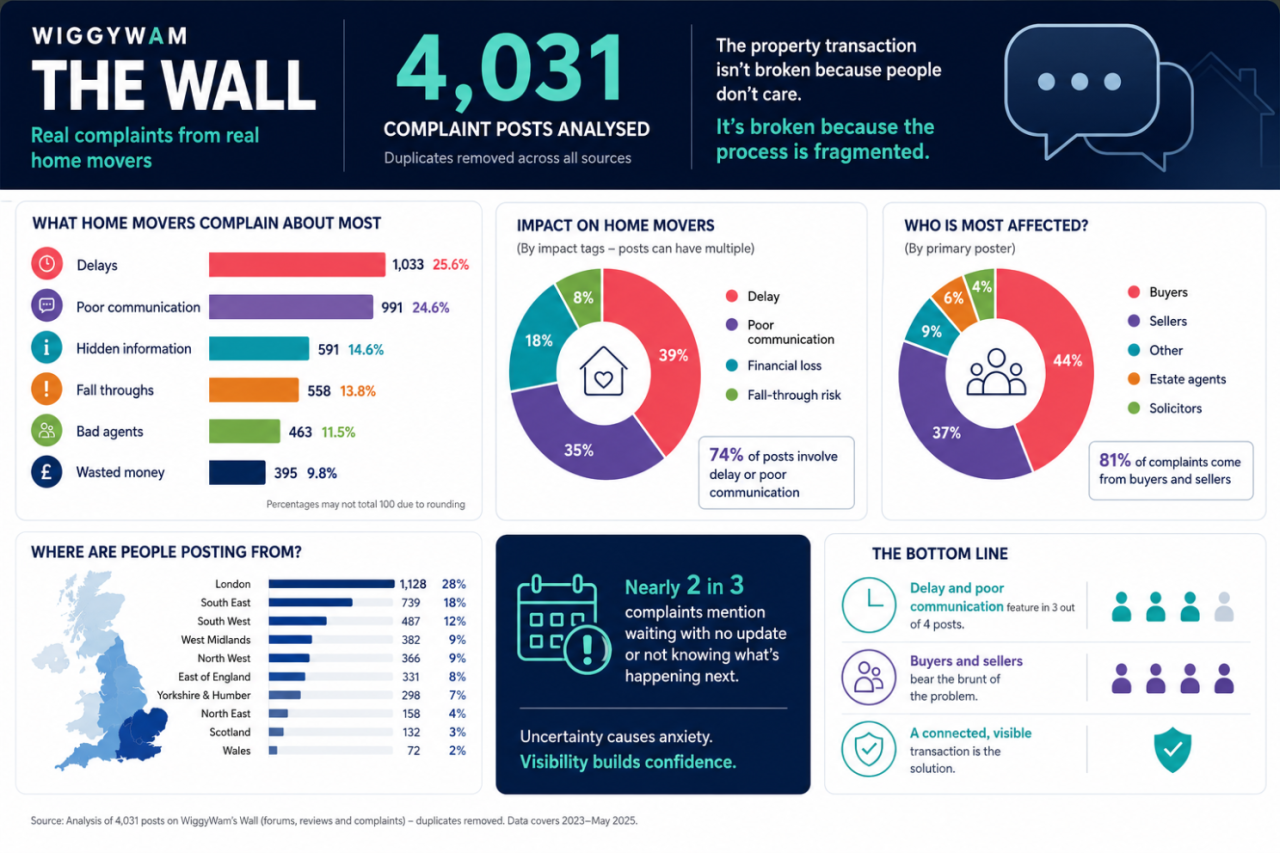
This is not simply a theoretical problem. We analysed WiggyWam's Wall of complaints and removed any potential duplicates. The resulting analysis contained 4,173 unique complaint records. Of those, 1,549 complaints, just over 37 per cent, were linked to delay or poor communication. When hidden information was included, the figure rose to 2,086, exactly half of the complaints analysed.
Buyers and sellers accounted for more than 86 per cent of complaints associated with delay or poor communication. They described unanswered calls and emails, repeated chasing, unclear timescales, missing paperwork and being told that the transaction was waiting on somebody else without knowing what remained outstanding or who needed to act.
Some feared that their mortgage offer would expire or the property chain would collapse. Others considered returning the property to the market because the transaction appeared to have stopped moving. Complaints described files falling through the cracks, documents being repeatedly requested and important information being known but not communicated.
These accounts do not necessarily mean that no work was taking place. They show that the people depending on the transaction could not see it. Progress remained buried within separate businesses and systems, leaving buyers and sellers to rely on fragments of information passed between people who could only see their own part of the move.
The Wall is a collection of complaints rather than a representative national survey, so these figures should be viewed as evidence of recurring problems rather than a measurement of every UK transaction.
Even with that qualification, the pattern is difficult to ignore. Poor visibility creates chasing, chasing consumes professional time, and unexplained delays place confidence, finances and the transaction itself at risk.
Different responsibilities should not mean separate transactions
A connected transaction does not mean removing professional independence or placing one person in control of everyone else. The estate agent understands the seller, buyer, property and chain. The seller's solicitor prepares the legal documentation and protects the seller. The buyer's solicitor investigates the property and advises the buyer. The mortgage broker manages the finance, while the buyer and seller make the decisions that shape the move.
Each person needs different information and must remain responsible for their own professional judgement. The problem begins when those roles become isolated.
A mortgage issue may affect the expected completion date, but the wider transaction may not know about it. A missing document may delay the legal work while the agent continues telling the seller that everything appears to be progressing. The buyer may believe nothing is happening because the work being carried out by the solicitors is invisible to them. The answer is not to expose every document or private conversation to everyone involved. It is to provide enough shared visibility for each person to understand the progress of the transaction and recognise when their action is required.
Joining the transaction should be effortlessCollaboration technology can create another problem before it solves the first one. Businesses hear the word platform and assume they will need to replace existing systems, migrate data, commission integrations and involve technical teams before anyone can begin using it. That creates cost, delay and resistance.
The Moving Hub is designed differently. An estate agency, law firm or mortgage brokerage does not need to replace the specialist systems it already uses. Once a professional is assigned to the transaction, they log in and become part of the shared environment. The same applies to the buyer and seller.
There is no lengthy integration project required before people can begin working together. The estate agent can continue using their CRM. The solicitor can retain their case management system. The broker can continue working through their existing mortgage platform.
The Moving Hub sits across those separate businesses as the shared transaction layer they currently lack. It does not attempt to run each professional's business. It gives them one place to come together around the property move they are handling jointly. They are assigned, they log in and they can begin.
That simplicity matters. A new way of working will not transform the market if it is too difficult, expensive or disruptive to adopt. The Moving Hub is none of those.
The right information must reach the right personShared visibility does not mean unrestricted access. A seller should not see confidential discussions between professionals. A buyer should not have access to sensitive information that has not been authorised for them. A mortgage broker does not need every document held within the seller's legal file. Security begins by recognising that the transaction contains different levels of information.
Access within the Moving Hub is based on the person's relationship to the transaction and the role they have been assigned. Buyers, sellers and professionals enter through their own dashboards and see the areas relevant to them.
The Seller's Pack holds the property information, forms and supporting evidence prepared for the sale. Appropriate access can be provided to the seller and authorised professionals.
The Property Workspace provides the wider communication and progress environment. It brings the authorised transaction members together around milestones, tasks, updates and suitable shared documents without making everything visible to everyone.
Professional-to-professional messaging gives agents, solicitors and brokers a separate place to communicate when a discussion should not take place in front of the buyer or seller.
Transaction-specific video meeting rooms are restricted to the people assigned to that particular move. They are not public links or general rooms shared across unrelated transactions.
The objective is not to place every piece of information in one open folder. It is to give each authorised person access to what they need while keeping sensitive information within the correct boundaries.
Progress should be visible without constant chasingA connected transaction should do more than store information. It should show movement. Within the Moving Hub, property workspaces bring together the tasks, milestones and updates associated with the transaction. When a seller completes a form or provides supporting evidence through the Seller's Pack, the related progress can be reflected within the workspace. Authorised members can see what has been completed, what remains outstanding and which person or profession needs to act next.
Each role also has its own dashboard. The seller does not need the same view as the solicitor, and the mortgage broker does not require the same information as the estate agent. Each participant sees the transactions they are involved in and the areas requiring their attention.
The complaints on the Wall show that silence is rarely experienced as neutral. When buyers and sellers cannot see progress, they assume that nothing is happening and begin chasing everyone involved. Making routine progress visible does not remove the need for personal communication. It allows those conversations to focus on decisions, risks and genuine problems rather than repeatedly establishing the basic position of the transaction.
Professionals spend less time reconstructing updates, while buyers and sellers receive reassurance that the move is still progressing.
The chain viewer adds another layer by recognising that an individual sale does not exist in isolation. A delay affecting one property may have consequences for several others, which is why visibility matters beyond a single buyer and seller.
One source of progress, not one person in controlThe Moving Hub is not designed to appoint one professional as the controller of the transaction. No estate agent should direct a solicitor's legal judgement. No solicitor should be expected to manage the mortgage application. No broker can resolve every issue affecting the property or the chain.
What the transaction needs is not one person controlling every decision. It needs one shared place where progress can be understood. Each professional remains responsible for their own work. The difference is that their contribution no longer disappears inside a separate system that nobody else can see.
This allows issues to be identified earlier, responsibilities to become clearer and conversations to take place with better information. It also allows high-calibre professionals to work together without surrendering their independence.
The Moving Hub connects what the current process separatesThe Seller's Pack prepares the property before a buyer is found. The live Moving Hub carries that preparation forward and connects it to the people, communication and progress of the transaction.
The work does not have to begin again when an offer is accepted. Documents do not need to be repeatedly requested, and each new participant does not have to create another disconnected version of events.
The property industry does not need another system that only works after every participating business has completed a major technology project. It needs a secure shared environment that professionals, buyers and sellers can enter easily while continuing to use the specialist systems their own work requires.
One property transaction should not be managed through six separate versions of the truth. It should have one connected source of progress, with the right people seeing the right information at the right time. That is how separate professionals begin working as one transaction.
Source note: The Wall analysis combined 4,326 complaint records from ten WiggyWam datasets. After 153 duplicate or near-identical entries were removed, 4,173 unique complaint records remained. The Wall is a complaint collection and not a representative national survey.
This Is Your Signal
Some people look at the way things work and accept it. Others look at the same problems and quietly think, there has to be a better way. WiggyWam is being built for the second group - the people, professionals, businesses and communities who believe better connection, clearer communication and smarter ways of working are not just possible, but overdue. Register your interest, tell us what you think, and find out where you fit in:
Stay Informed
When you subscribe to the blog, we will send you an e-mail when there are new updates on the site so you wouldn't miss them.

Comments