
The Hidden Economy Inside Every Home Move - and Why The UK Is Wasting Too Much of It
One of the most useful things about writing publicly is that occasionally somebody responds in a way that makes you realise the argument is bigger than the one you originally set out to make. I wrote recently about the extraordinary financial burden carried by UK estate agents in a transaction system where they can spend money winning an instruction, market a property, find a buyer, negotiate the sale and then wait months before receiving their fee. If the transaction collapses, much of that work and expenditure can disappear with it.
One of the responses came from somebody with considerable experience of home moving matthew faizey who pointed out that I had forgotten removals companies. His argument was simple. A collapsed property transaction may eventually come back together for some of the professionals involved, but a removals business that has reserved vehicles, staff and a particular date may never recover that capacity. Once the date has passed, it has gone. The overheads remain, but the revenue attached to those vans and those people can disappear completely. He was right, and it made me look at the problem differently.
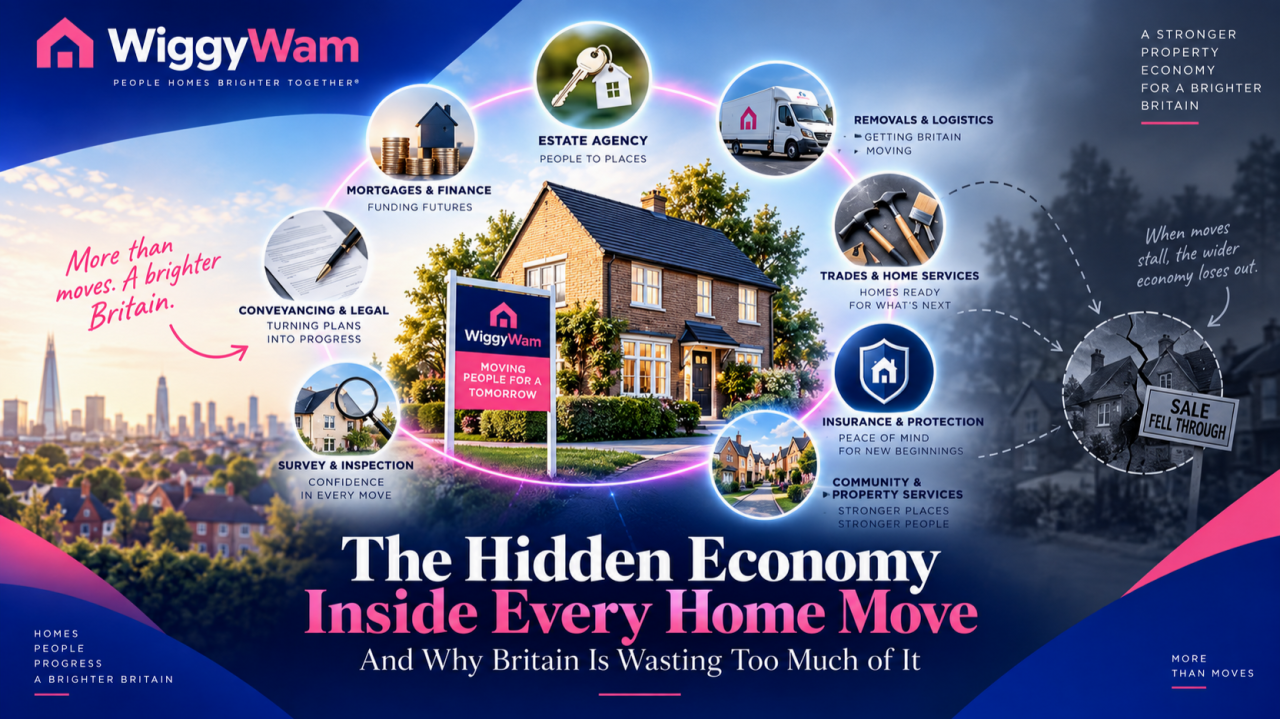
We spend an enormous amount of time discussing the property transaction as though it belongs primarily to the property industry. In reality, every home move creates a temporary economy around it. When somebody moves home, an extraordinary collection of businesses, professionals, workers and services begins organising activity around that one event. When the transaction succeeds, money flows through that little economy. When it fails, the consequences spread considerably further than the buyer and seller whose names appear on the memorandum of sale.
Perhaps that is one of the reasons we have tolerated such an inefficient home-moving system for so long. Most have been looking at individual transactions when they should have been looking at the economic ecosystem surrounding them.
A completion releases far more than a set of keys
Think about what actually happens when somebody decides to move home. Before a completed move ever takes place, businesses have already begun committing resources. Property has been prepared and marketed. People have spent time advising, inspecting, searching, verifying, negotiating and arranging. Vehicles and staff may eventually be allocated. New furniture might be ordered, insurance arranged, renovations contemplated, trades contacted and services transferred. Money begins moving through an expanding network of activity long before somebody finally carries a box through their new front door.
Government itself now acknowledges that the economic impact of home moving extends beyond housing into areas including removals, construction, retail and commercial property. Its latest reform programme says an efficient home-moving system matters not merely for individuals but for the wider economy, because moving allows people to relocate for employment, settle into appropriate homes and release all of the associated economic activity surrounding that decision. That wider context deserves much more attention.
A completion is not simply the moment an estate agent receives a commission or a solicitor closes a file. It is the point at which a whole sequence of planned economic activity can finally become real.
The opposite is also true. When a transaction collapses, we tend to count the most obvious costs: legal fees, survey costs, mortgage expenses and perhaps the lost estate-agency commission. But those figures do not fully describe what has been lost. They do not necessarily capture the removals slot that could not be resold, the work somebody declined because they expected to be somewhere else, the staff hours consumed progressing a transaction that never happened, or the purchases and services postponed because the household itself never moved.
Government figures put the direct wasted cost to buyers and sellers from failed transactions at around £400 million a year, while estimating the wider economic cost at up to £1.5 billion annually. Around one transaction in three currently falls through, and the average period from accepted offer to completion remains about 120 days. Those are not simply poor customer-service statistics. They describe an enormous amount of economic activity being delayed, duplicated or destroyed.
We have organised the industry around transactions rather than moves
I think there is a subtle but important distinction here. The industry tends to see a property sale as a collection of professional transactions. There is an estate-agency instruction, a mortgage case, a conveyancing matter, perhaps a survey instruction and eventually a removals booking. Each has its own systems, commercial relationships, terminology, processes and measures of success.
That is completely understandable from the perspective of the businesses involved, but it is not how the person moving experiences any of it. They are having one event in their life. They are moving home.
That difference in perspective explains a surprising amount about why the process remains fragmented. We have spent decades improving individual professional activities without creating an environment built around the event connecting them all. UNTIL NOW THAT IS.
The consumer therefore becomes the common thread almost by accident. They carry information between businesses, repeat things they have already provided elsewhere, ask one professional what another is waiting for and try to assemble a mental picture of a transaction that no single participant can necessarily see in its entirety. The businesses around them experience a similar problem. Each can work extremely efficiently within its own boundaries while the overall move remains slow.
That is why I increasingly think most have been trying to optimise the wrong unit. The unit that matters is not simply the estate-agency transaction, the conveyancing file or the mortgage application. It is the move.
This also changes how we should think about speed
There has been considerable discussion this week about Rightmove's chief executive wanting to reduce the period from agreed sale to completion from roughly 150 days to around 40. I do not think the important story is that Rightmove wants to move further into the transaction. We have already spent enough time talking about portals. The important thing is that a 40-day expectation is now being discussed seriously at this scale.
Once expectations begin moving in that direction, transaction speed stops being a relatively abstract industry reform issue and becomes an economic one.
Reducing a move by two or three months would bring income forward throughout the ecosystem surrounding it. Businesses would wait less time to be paid, households could commit to services with greater certainty, booked resources would spend less time exposed to cancellation and transactions would have a shorter period in which circumstances could change sufficiently to destroy them.
This is why I think the industry's obsession with faster transactions has sometimes been framed too narrowly. We talk about reducing stress for consumers, and obviously that matters. We talk about improving agency cashflow, which matters enormously too.
But a functioning home-moving market is an economic circulation system. Speed improves circulation. Certainty encourages commitment. Completion releases activity. A transaction sitting unresolved for another hundred days is not simply a frustrated buyer staring at their phone waiting for an update. It is a collection of businesses, purchases, decisions and economic activity sitting behind that buyer waiting for permission to happen.
The fall-through rate becomes even harder to justify when viewed this way
Around one in three failed transactions is an extraordinary figure when you stop thinking about it as a property statistic. Imagine another part of the economy routinely constructing a complicated chain of commercial activity around three customers while accepting that one entire chain may simply disappear before anyone reaches the intended outcome. We would immediately begin questioning the underlying process.
Yet in property, failure has become so familiar that businesses have adapted themselves around it. Fees compensate for transactions that never pay. Pipeline calculations assume that some agreed business will disappear. Progression teams spend enormous amounts of time trying to prevent things drifting apart. Consumers themselves enter the process knowing that an accepted offer still provides remarkably little certainty.
Government reform is now attempting to change this through earlier information, sales packs, more digital data and earlier forms of commitment. It expects its current programme to cut transaction times and reduce fall-throughs substantially.
I welcome that direction, but I think the industry should aim considerably higher than simply making today's process slightly less painful. They should be asking what a home-moving environment designed around successful completion would look like if they were building it now. That is a very different question. That was our approach when building WiggyWam many years ago.
The eco-system to achieve what government are only now talking about is already here. That platform is WiggyWam
For a long time, it has been tempting to describe WiggyWam by listing everything inside it. There is a property portal, professional marketplace, Sellers Pack, Moving Hub, Property Workspaces, community, professional content and the wider network around property.
The problem with explaining it that way is that it can sound as though we simply decided to build an unusually large collection of property features. That is not actually the idea. The idea is much simpler. The move itself has never really had a home.
The property has a portal. The professionals have their specialist software. The legal matter has its case-management environment. The mortgage has another system. The customer probably has an inbox full of messages from all of them. What has generally been missing is an independent place built around the move and the people participating in it. That is the distinction I think matters.
WiggyWam does not need to own the estate agency receiving the instruction, the lender providing the mortgage or the legal business handling the conveyancing. We have no commercial reason to decide that one professional should receive the work instead of another. Our interest is in the move succeeding.
That neutrality becomes increasingly important as more organisations begin trying to connect different stages of the property transaction. We discussed recently the risk that transaction infrastructure could eventually become commercially interested infrastructure, where the easiest route through the move also happens to favour services connected to the organisation controlling that route.
I think there is another model. The transaction environment can remain neutral while the businesses around it compete. The consumer can choose the people they trust. Those professionals can keep the specialist systems they need. The common layer should simply make it easier for the move to progress between them.
And the ecosystem is wider than we have sometimes described it
The comment about removals companies made this particularly clear to me. If WiggyWam genuinely intends to organise itself around the move rather than merely around the legal property transaction, then the ecosystem has to recognise everybody whose livelihood is connected to people successfully moving home. That includes businesses that may never touch a contract of sale but are economically dependent upon the completion date becoming real. The same is true after somebody moves.
The economic relationship with property does not finish at completion. The new owner may need decorators, builders, electricians, plumbers, insurance, furniture, security, landscaping or any number of other services. Over time they may refinance, renovate, become a landlord, buy again or sell.
That means the economic value created by one property relationship can continue for years. The traditional property transaction captures a relatively brief moment inside that much larger lifecycle. WiggyWam has been deliberately built around the lifecycle.
This is also why our Marketplace, community and content environment matter just as much strategically as the transaction tools. They give people and professionals reasons to remain connected after the removal van has left rather than returning everyone to the internet to find one another again next time.
This is where I think property technology has always been thinking too small
The industry understandably evaluates technology according to the immediate problem it solves. Does it generate leads, speed up onboarding, automate a task, improve compliance or reduce administration? All useful questions. But they encourage them to keep building around individual activities rather than asking what happens to the system as a whole.
The more interesting measure might be whether the technology increases the probability that the move completes successfully and whether the economic relationships created around that move survive afterwards. That changes what success looks like.
A platform generating another thousand enquiries may be valuable, but so is preventing ten existing transactions from collapsing. A piece of technology shaving minutes from an administrative task may improve productivity, but so does removing several weeks from a transaction. Helping one business capture a referral has value to that business, but creating an environment where the consumer can confidently choose from an open market creates something quite different. I think the industry is reaching the point where those wider questions are becoming unavoidable.
Government reform is pushing information earlier. Expectations around completion speed are changing. AI is changing discovery. Large commercial organisations are building connected transaction ecosystems. Consumers increasingly expect to understand what is happening rather than simply accept months of silence and chasing. Against all of that, another isolated piece of software feels less interesting than it once did. The bigger opportunity is architecture.
We should build around what everybody ultimately needs to happen
What we want WiggyWam to become is not the system that wins because it captures every service involved in moving home. We want it to win because more moves succeed through it.
There is an important difference. If the independent estate agent completes sooner, that is good for the ecosystem. If the consumer chooses their own solicitor and the transaction progresses smoothly, that is good for the ecosystem. If their existing mortgage broker remains involved, that is good for the ecosystem. If the removals company can book the move with greater certainty, that is good for the ecosystem. If the homeowner remains afterwards and later finds a local professional through the Marketplace, that is good for the ecosystem.
WiggyWam does not have to own those businesses to benefit from creating an environment in which they can all prosper. That, to me, is what independence should mean in property technology. And it is perhaps the clearest explanation yet of why we have built something much broader than another portal or another transaction application.
Every successful home move creates an economy around it. Every unnecessarily slow move holds part of that economy back, and every failed one destroys a portion of it. Once you see home moving that way, the problem we need to solve becomes much bigger than improving conveyancing or producing better property listings.
It becomes about creating an environment in which the whole move has a better chance of succeeding, the people and businesses around it can work together without surrendering their independence, and the economic relationships created during that move do not have to disappear the moment somebody collects the keys.
That is the opportunity I think we should be talking about now. Not simply how we digitise another part of the property transaction, but how we stop wasting so much of the value that already exists around every person trying to move home.
Whilst everyone else is talking about what is needed. WiggyWam has already built 99% of the solution. If you want to be part of an exciting new phase, or be part of a community that helps shape the direction our platform goes in. Then get in touch.
Andrew Glendinning Sarah Lim Iain McKenzie Dan Wass Gareth Griffiths James A. Brown Frances McCann Richard Ingle Scott Devereux Janet Bedford Mandy Wilcock Adam Evetts Darren Ditchburn Caroline Domanski MBE Steven Bartlett Touker Suleyman Adam Noonan Gareth Samples
COM_EB_SUBSCRIPTION_FORM_DESC
