
AI Isn't Killing Your Website. It May Make Owning One More Important Than Ever.
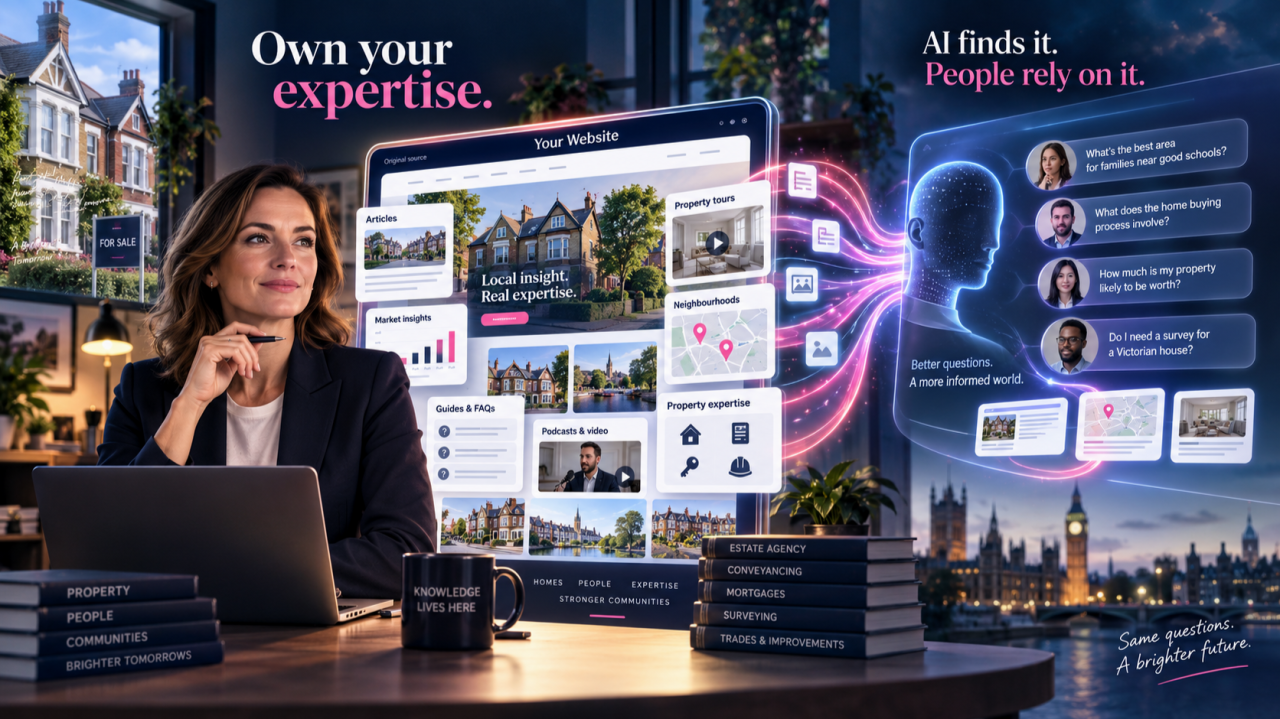
There is a growing assumption that AI is going to make business websites less important. After all, if people can ask Google, ChatGPT or another AI system a detailed question and get a neat answer back without trawling through pages of search results, why would they bother visiting individual websites at all? I am not convinced that is where this is heading. In fact, I think we may end up discovering the exact opposite.
The more search becomes conversational and AI-driven, the more important original information becomes. AI still needs something to work with. It needs knowledge, experience, opinions, local insight, commentary, case studies, photographs, videos and answers to real questions. Somebody still has to create all of that in the first place. For property professionals, that makes your own website incredibly important because it is one of the few places online where you completely control the source material.
Your website should become the place where your knowledge lives
For years, plenty of business websites have been little more than digital brochures. There is a homepage, an about us page, a list of services, some staff profiles and perhaps a blog that gets updated when somebody remembers it is there. That made sense when the main objective was simply to have a website and hopefully get it ranking on Google. But the world we are moving into looks very different.
If consumers are increasingly asking detailed questions in natural language, then the websites that become valuable are likely to be the ones that actually contain useful answers. That means an estate agent talking about what is genuinely happening in their local market, a conveyancer explaining the things buyers and sellers regularly get confused about, a broker discussing what mortgage changes really mean, or a surveyor showing the types of problems they actually find in homes. That sort of content is useful because it comes from experience.
It is not another generic article called “Five Tips for Selling Your Home” that could have been written by any estate agent in the country, or indeed AI itself. It is your knowledge, your area, your experience and your view of what is happening. That difference could become incredibly important.
AI still needs somewhere to learn from
There is a slightly odd contradiction developing at the moment. At exactly the same time as businesses are asking whether websites are becoming less important, search engines and AI systems are becoming more dependent on useful information being published somewhere.
AI can summarise, interpret, compare and organise information brilliantly, but it cannot endlessly feed on versions of information that have already been summarised by other AI systems. Somewhere down the line there still needs to be an original source and fresh content.
An estate agent needs to know what is actually happening to asking prices in their town. A solicitor needs to understand the legal issue they are explaining. A broker needs to know what lenders are doing. A tradesperson needs to have carried out the work they are talking about. That experience has to enter the digital world somewhere. For many businesses, the obvious place should be their own website.
That does not mean every AI system will always send the consumer directly to your site. That is where the real change may be happening. The website remains important, but the route to it is becoming less predictable.
A consumer might not search for your business name, look through a list of blue links and then click onto your homepage. They may instead ask a very specific question and allow an AI system to decide which sources or businesses are most relevant. That makes the quality of what you publish more important, not less.
Being online is not the same as being worth finding
There are thousands of property businesses online saying broadly the same things. They offer excellent customer service. They are friendly. They are experienced. They offer a personal approach. They know the local market. None of that is necessarily untrue, but it gives search engines, AI systems and consumers very little to distinguish one business from another. The interesting material is usually much deeper than that.
It is the estate agent explaining why one part of town is selling faster than another. It is the conveyancer explaining why a particular leasehold issue keeps delaying transactions. It is the broker explaining what they are seeing with first-time buyers. It is the surveyor showing what a certain type of cracking actually means. It is the builder talking through a renovation problem they have just solved. That content proves expertise without needing to keep telling people you are an expert. It also starts building something far more valuable than a collection of sales pages. It creates a body of knowledge around the person and the business.
The website is one of the few things you really own
There is another reason I think websites matter more than ever. Most businesses now publish heavily onto platforms they do not control. LinkedIn, Facebook, Instagram, TikTok, YouTube and Google can all be brilliant places to reach people, raise awareness of your business, share news and more, and I would not suggest for a second that businesses should stop using them. But as we have seen with many of these platforms, algorithms change. Reach changes. Features disappear. Accounts get restricted. And after a while, very few connections are seeing your content - unless you have a big marketing budget that is. What worked last year suddenly stops working. Your own website is different.
It should be the permanent home of your expertise. The articles, videos, podcasts can all be shared on those platforms, and the commentary can be discussed elsewhere, but the original piece of content should have somewhere to live that the business controls. I like to think of the website as the library and everything else as the distribution network. The more valuable the library becomes, the more there is for people, search engines and AI systems to discover.
But owning the source is only half the job
This is where it links back to the wider problem I wrote about recently. A business can produce fantastic content and still end up repeatedly paying to reacquire the same people. Someone reads your article, learns something useful, visits your website and then disappears. Three years later, when they actually need your service, they go back to Google and start searching again.
We have become very good at attracting attention and much less good at keeping the relationship alive. That is why I think the bigger strategy has two parts. First, own your expertise. Publish it properly and make your website somewhere genuinely worth finding.
But then think about what happens to the person afterwards. How do they stay connected to you? Why would they continue reading what you write? Where do they see your next update? How do you remain familiar to them long before they actually need your service? That is the bit many businesses still overlook.
Not everybody reading your content needs something today
Property marketing tends to focus heavily on the person who is ready to transact right now. We want the seller asking for a valuation, the buyer looking for a property, the borrower who needs a mortgage or the client ready to instruct a solicitor. But most people are not permanently sitting in that moment.
A homeowner may follow local property news for years without any intention of selling. A first-time buyer could spend eighteen months learning before speaking to a broker. Someone may read a conveyancer’s explanation about leasehold long before they ever need one. A homeowner could follow a tradesperson’s work because they know they will eventually renovate. Those are not wasted audiences.
In many cases, they may be the most valuable people to build a relationship with because when the need finally arrives, they already know who you are. That changes the way we should think about content. It is not simply there to generate a lead today. It is there to create familiarity for tomorrow.
Perhaps businesses need to start thinking like publishers
I think that may be one of the biggest changes AI brings. Instead of thinking of the website as a static shop window, perhaps property professionals need to start thinking of themselves partly as publishers. Not publishers in the traditional newspaper sense, but businesses that continually share what they know.
What is happening in the market? What are customers asking? What are you seeing that the public might not understand? What mistakes keep being made? What do you wish more clients knew before they came to you?
There is an endless supply of useful content sitting inside every experienced property business. The problem is that most of it stays inside people’s heads. AI cannot discover expertise that has never been published. Neither can a potential customer.
This is not about fighting AI
I do not think the answer is to worry about AI taking traffic away from websites. The much more useful question is how to make your business valuable in an AI-driven world. That means creating original information worth discovering. It means building a website that does far more than describe your services. It means developing a recognisable voice and sharing genuine expertise rather than filling pages with generic marketing copy. And it means understanding that while search engines and AI systems may help people discover you, the long-term value lies in what happens after that discovery.
That thinking is also part of what sits behind WiggyWam. Not because I think property professionals should stop investing in their own websites. Quite the opposite. I think they should make them stronger, publish much more of what they know and treat their website as a serious business asset.
The wider opportunity is to give that expertise somewhere else to travel too, so that it can become part of an ongoing relationship rather than a single visit from a search result. Because perhaps the website is not dying at all. Perhaps we have simply underestimated what it should be. This is where WiggyWam helps. It links back to their websites. The platform is also niche to the UK and property: UK businesses are more visible - bigger fish in a smaller pond if you like.
In an AI-driven world, your website should not just tell people that you exist. It should show what you know, demonstrate how you think and become the place where your expertise permanently lives.
And if AI really is going to play a bigger role in deciding what information and businesses people discover, then making sure there is something genuinely worth discovering could become one of the smartest investments a property professional makes.
When you subscribe to the blog, we will send you an e-mail when there are new updates on the site so you wouldn't miss them.
