
7 minutes reading time
(1305 words)
Legal estates and beneficial interests: what’s the difference?

In England and Wales, property ownership is divided into ownership of the “legal estate” and ownership of “beneficial interests”. This guide explains them in simple terms. It also touches on different ways two or more people can own property together.
What is a legal estate?
When you buy a property in England and Wales, HM Land Registry (HMLR) records who owns the legal estate - this is the person (or people) shown as registered proprietor(s) on the register of title. The legal estate is sometimes called the “legal title” or “registered title”.
The legal estate can't be divided into shares.
If two or more people are registered as proprietors, they are called joint proprietors.
Being the owner of the legal estate does not always mean you are the person who benefits from the property. The people who benefit from the property are the owners of the beneficial interest; they may be different from the owners of the legal estate.
What is a beneficial interest?
It may be easiest to think of the beneficial interest as being the right to benefit from the property. This usually means:-
- the right to live in or use the property, and
- the right to receive the sale proceeds if the property is sold.
Beneficial interests are sometimes called “equitable interests” or “interests under the trust”.
Beneficial interests can be divided into shares, and the percentage shares don't need to be equal.
For example, one owner could own 25% of the beneficial interest and the other owner could own 75% of the beneficial interest.
Imagine an old-fashioned glass jar full of sweets:
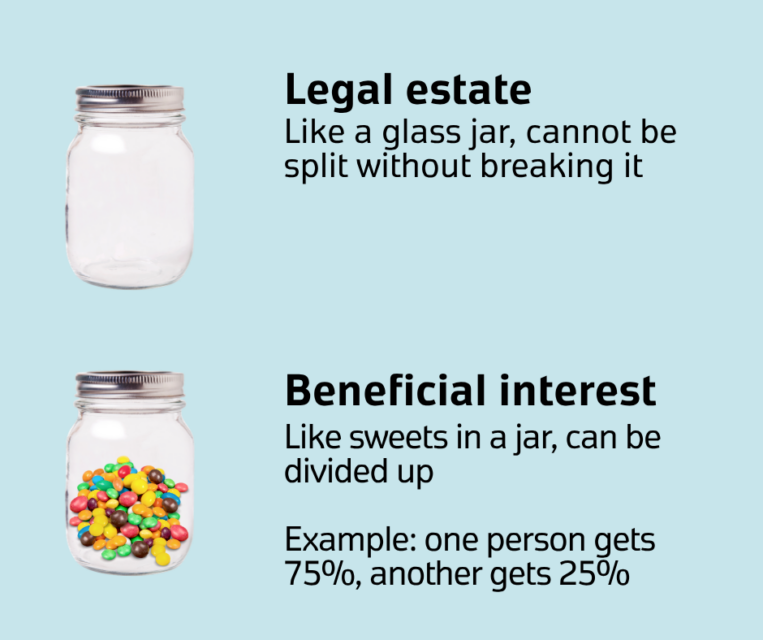
- The glass jar is like the legal estate in land. It can only exist in one piece and can't be divided up. Two or more people can own it at the same time, but they can't split it up without breaking the glass. The owners of the jar (just like the owners of the legal estate) can only ever own the whole thing together, not in separate pieces.
- The sweets inside the jar are like the beneficial interest in land. They can be divided up separately between different people in different proportions. One owner may own, say, 75% of the sweets and the other owner may own 25% of them.
Why is the difference important?
There are important differences between the legal estate and the beneficial interest, such as:
- HMLR only records ownership of the legal estate in the register of title, not ownership of the beneficial interest.
- If two or more people own the legal estate, they automatically own it “on trust” for the owners of the beneficial interest. Owners of the beneficial interest may be the same people as the owners of the legal estate, or they may be entirely different.
- If two or more people own the legal estate, they can only own it as “joint tenants”. Here, “tenant” simply means co-owner and has nothing to do with a lease or tenancy agreement. This means that the legal estate (like the glass jar) can only be owned together as a whole and can't be divided up into separate pieces.
- If two or more people own the beneficial interest (like the sweets in the jar), they can own it in different shares and in different ways.
Different ways of owning the beneficial interest
If two or more people own the beneficial interest, they can own it in different ways:
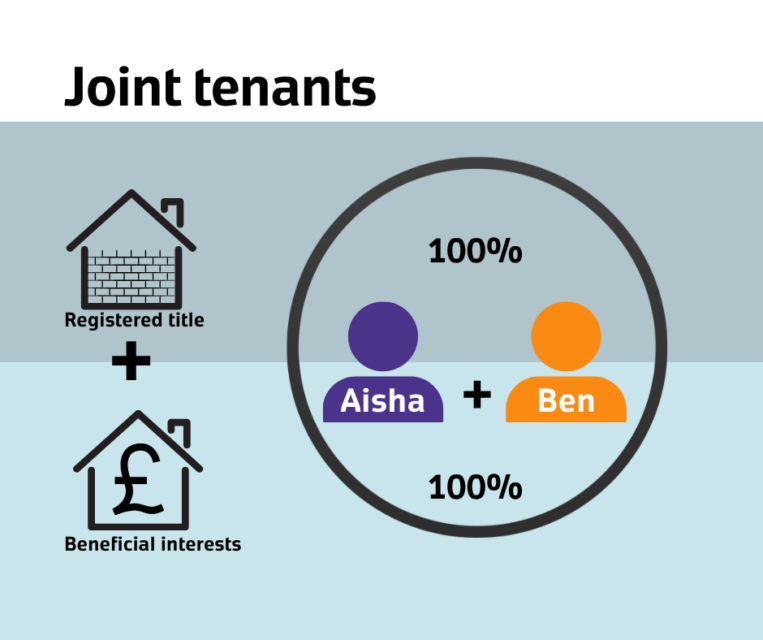
1. “Joint tenants”
- own the whole beneficial interest together
- don't have a specific “share” in the beneficial interest
- can't give away, sell, mortgage or leave a share in their will to anyone else
When one owner dies, the beneficial interest automatically belongs to the other, surviving, owner(s).
If only one surviving owner is left, that person owns all of the beneficial interest.
Example: Aisha and Ben own both the legal estate and the beneficial interest as joint tenants:
2. “Tenants in Common”
- each own a separate share in the beneficial interest (for example, 50% each, or 25% and 75%)
- can give away, sell, mortgage or leave their share in their will to someone else
If one owner dies, that person’s share goes to whoever inherits their property – it does not automatically go to the other owner(s) of the beneficial interest.
Example: Sara and Abdul own the legal estate as joint tenants (which is the only way it can be owned) but own the beneficial interest as tenants in common – in this case in 75% and 25% shares.
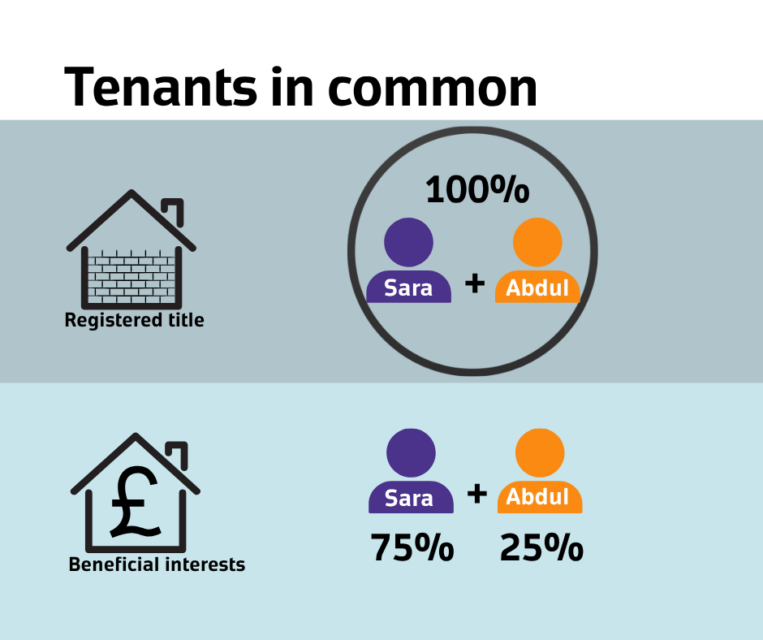
In this example, the legal owners are the same as the owners of the beneficial interest, but that might not always be the case.
There are other, more complicated, ways of owning the beneficial interest which involve trusts but those are beyond the scope of this blog.*
How to find information about the beneficial interest
People often ask: How do I know if a property is held on trust and who the owners of the beneficial interest are?
Although HMLR records ownership of the legal estate (the glass jar), but not ownership of the beneficial interest (the sweets), there are a few things you can check:
1. Is there a “Form A restriction” in the register?
A Form A restriction does not use the words “tenants in common”. This is what to look for to see if that restriction is in your register:
“No disposition by a sole proprietor of the registered estate (except a trust corporation) under which capital money arises is to be registered unless authorised by an order of the court.”
A Form A restriction in the register usually means that:
- the legal estate is held on trust
- the owners of the beneficial interest may be different to the owners of the legal estate
- generally (although not always) the owners of the beneficial interest own it as tenants in common
There will not usually be a Form A restriction in the register if the owners of the beneficial interest own it as joint tenants.
2. Are there any other relevant documents, such as a “trust deed”?
A “trust deed” is sometimes used to specify how the beneficial interest is owned and by whom. You may also find this information in, for example, the property transfer form. If there is a trust deed separate from the property transfer form, it may not have been sent to HMLR. In that case, your conveyancer may be able to give you more information.
Where to learn more
For more information see our guide Owning a property with someone else
You can also look at our blog What kind of joint ownership do I have?
Key takeaways
- Legal estate = the “official” legal ownership of the land, recorded by HMLR.
- Beneficial interest = the “real” benefit of the land, such as rights to occupy it or receive any sale proceeds, not recorded by HMLR.
- The owners of the beneficial interest may be different from the owners of the legal estate.
- The legal estate can only be owned together as “joint tenants”.
- The beneficial interest can be owned together as “joint tenants” or in separate shares as “tenants in common”.
- You can find out about beneficial interests by seeing if there is a Form A restriction in the register and looking at other documents such as trust deeds.
* Further information on this topic, in general, can be found in Practice Guide 24, which covers private trusts of land and Practice Guide 19, which deals with how beneficial interests can be protected.
We welcome your comments about this blog in the comments below. Please note that we are unable to discuss individual cases through the comments section and would request that all such queries be directed to our Contact Us web form where you will receive a response as soon as possible.
Original author: HM Land Registry Assistant Land Registrars
This Is Your Signal
Some people look at the way things work and accept it. Others look at the same problems and quietly think, there has to be a better way. WiggyWam is being built for the second group - the people, professionals, businesses and communities who believe better connection, clearer communication and smarter ways of working are not just possible, but overdue. Register your interest, tell us what you think, and find out where you fit in:
Stay Informed
When you subscribe to the blog, we will send you an e-mail when there are new updates on the site so you wouldn't miss them.

Comments