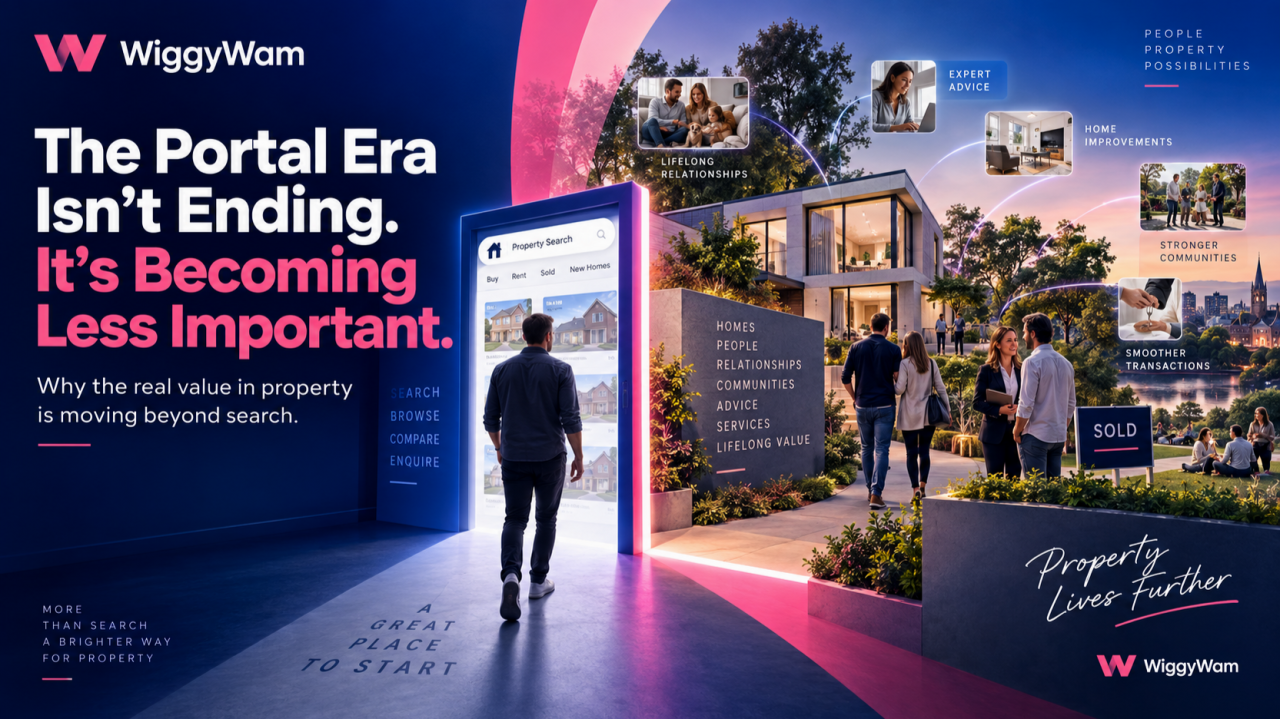
For more than twenty years, the property industry has treated the portal as the centre of the digital property world. That made complete sense at the time. The great innovation was taking thousands of properties that were scattered across estate agency windows, newspapers and individual websites and putting them somewhere consumers could search in one place. It changed the market because it solved a genuine problem. Finding property used to be difficult. The portal made it easy. But once something becomes easy, it stops being the thing that creates the greatest value.
That is the point I think the property industry may be approaching now. Property search is not disappearing. People will always need to know what is available, and there is obvious value in bringing that information together. But search itself is becoming less remarkable. Consumers expect it. They can find properties through portals, websites, social media, alerts, maps and, increasingly, conversational AI. The ability to display a photograph, price, description and floorplan is no longer the technological breakthrough it once was. The interesting question is what happens when the thing an industry has spent twenty years organising itself around becomes a utility.
We may have mistaken the front door for the building
For a long time, being where the consumer searched was everything. If the buyers were on a particular portal, the listings needed to be there too, and the more consumers congregated in one place, the more commercially powerful that place became.
That logic is still understandable, but it has created an unusual imbalance. We have allowed the moment somebody first sees a property to become one of the most valuable moments in the entire transaction, even though it is often one of the simplest. Finding a house you like can happen in an evening. Buying it can consume the next five months. The industry has spent decades improving the evening.
That is not a criticism of portals. They solved the problem they were built to solve extremely well. The question is whether the rest of us have continued treating that problem as though it is still the biggest one. I am increasingly convinced it isn't.
The really difficult parts of moving home happen after discovery. They involve confidence, information, preparation, coordination, uncertainty and time. People need to know whether a property is genuinely ready to sell, whether important information exists, what is holding things up, what needs doing next and whether the people involved are actually working from the same picture.
That is where a transaction succeeds or fails. Yet, commercially, the industry has historically attached enormous value to attracting the person's attention and comparatively little value to what happens once it has it.
Search is becoming a commodity
This is where I think AI changes the conversation again. For years, portals benefited from the fact that consumers needed somewhere to go and search. But the internet is gradually moving away from the idea that every task begins with visiting a destination.
We increasingly ask for what we want. We ask for a hotel that fits certain criteria. We ask for a restaurant suitable for a particular occasion. We ask software to compare things, summarise things and recommend things. Search is becoming less about learning which website to visit and more about expressing an intention. Property will move in the same direction.
Somebody will not necessarily think about which search box to open. They will describe the home they want, the area they like, how much they can afford and the things they care about. Technology will do more of the filtering and comparison around them.
That does not mean the listings disappear. Quite the opposite. Good data becomes essential. But the interface through which somebody discovers those listings becomes less defensible. If the consumer can get to essentially the same answer through multiple routes, then the greatest value eventually moves elsewhere. I think that is the strategic shift the property industry should be thinking about.
The next battle may be over continuity
The really scarce thing in property is not a property listing. It is continuity. A person begins thinking about moving long before they book a valuation or make an offer. They research areas, mortgages, prices and renovations. Eventually they enter a transaction. Then, if everything goes well, they complete and continue being a homeowner, renter, borrower or landlord for years afterwards. That can represent a relationship lasting decades. Yet the industry has traditionally organised itself around tiny moments inside that relationship.
One business captures the property search. Another captures the mortgage enquiry. Another captures the legal instruction. Another captures the home-improvement lead. Everyone competes intensely for the moment in which the customer happens to need their particular service. Then the moment passes. The customer goes back into the wild.
From a business perspective, that is an extraordinary amount of effort spent repeatedly recreating relationships that could have continued. And that is why I think the most important property platforms of the next decade may look very different from those of the last one. Their value may not be determined primarily by how many people arrive to search for a property. It may be determined by how many people have a reason to remain.
That changes what a platform actually is
We still tend to think about property platforms in categories. A portal is where you find property. A marketplace is where you find services. Transaction software is where you manage a move. A community is where people talk. Content lives somewhere else again. That division makes sense if you look at the industry from the perspective of the technology being sold. It makes much less sense from the perspective of the person using it.
Someone does not stop being interested in property once they have found a house. They do not suddenly become a completely different category of human being because they have moved from “searching” to “conveyancing”. Nor do they stop needing anything related to property once the keys are handed over. Those distinctions exist because businesses built products around individual commercial opportunities. The consumer's life is far less tidy.
That makes me wonder whether we are approaching a point where the most valuable property platform is no longer the one that performs one function exceptionally well, but the one that gives people fewer reasons to leave in the first place. Not because it tries to own every service itself, but because it creates continuity between them. That is a very different idea from a portal.
It also changes where the professional sits
There is another consequence which I think is even more important. In a portal-led world, the platform has the audience and the professional rents access to it. That model has become so normal that we rarely stop to question it. But if the next stage of property technology is about continuity rather than momentary discovery, then professionals have an opportunity to sit much closer to the customer.
Their own website becomes the permanent home of their expertise. Their content builds recognition. Their existing clients become part of an ongoing audience rather than a completed transaction. Their presence inside wider communities keeps them visible without requiring somebody to search for them again from scratch.
That is a much healthier model than constantly competing to interrupt a consumer at precisely the moment they happen to need something. It also gives independent businesses something they have gradually surrendered over the past twenty years: a stronger degree of control over their own future.
This is where my thinking about WiggyWam has changed
When we first think about online property, it is almost impossible not to think in portal terms because that is the model we have all grown up with. But I increasingly think building another portal would be aiming at yesterday's opportunity.
Of course WiggyWam has property search. It needs it. Property is one of the obvious reasons people enter the ecosystem. But I do not think the long-term value sits in getting somebody to search for a house and then sending them away again.
The much more interesting opportunity is everything surrounding that moment: the professional relationships, the preparation before a sale, the transaction itself, the information people need, the services they use around their homes and the community that can continue long after one move has finished.
In that model, property search is important, but it stops being the centre of gravity. It becomes an entrance. And I think that distinction matters enormously.
We may be watching the centre of the industry move
The last twenty years of property technology were largely about aggregation. Gather the listings. Gather the audience. Put the two together and build a business around the connection. The next twenty may be much more about continuity.
Who can create a relationship that begins before somebody moves, remains useful during the transaction and still has value once the move is finished? Who can help professionals stop repeatedly renting access to people they have already served? Who can turn expertise, community, transactions and services into something that becomes more useful as more of the property relationship happens within it?
Those are much bigger questions than who has the most listings. And that is why I do not think portals are about to disappear. They are too useful for that. I simply think we may eventually look back and realise that we mistook the most visible part of digital property for the most valuable part.
The portal solved the problem of finding the property. The next opportunity is solving everything that comes before, during and after it.