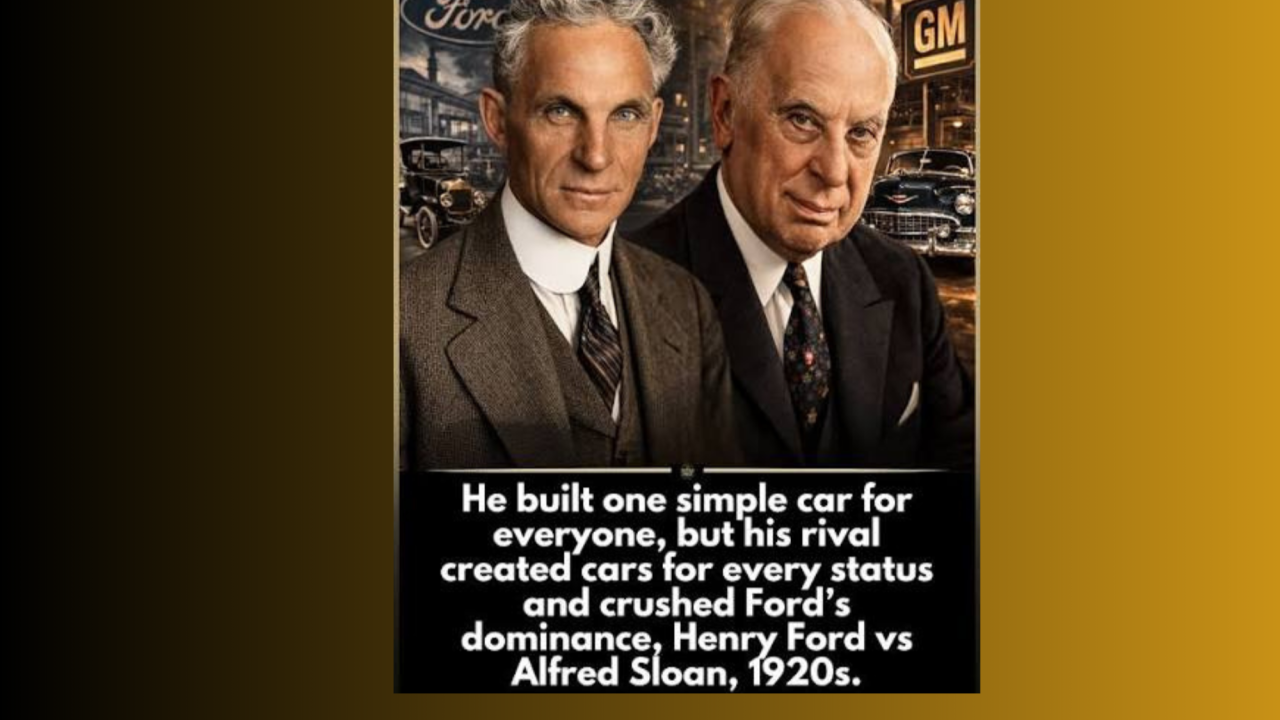
In June 1896, a Detroit engineer working nights in a rented shed finished the machine he'd spent months building, only to discover the shed door was too narrow to let it through. He picked up an axe and knocked a hole in the brick wall. His name was Henry Ford. The machine was his first working automobile, the Quadricycle.
Ford's genius wasn't the car. It was the factory. He treated production itself as the product, accounting for every motion, every minute, every constraint until the Model T's price dropped from $850 to $260 in barely a decade. By the early 1920s, Ford owned 60 percent of the American car market. Competence, applied with total focus, built an empire.
Then it stopped working. His own son tried to tell him that buyers wanted more than a reliable black box on wheels — they wanted to be seen. Ford's answer, on at least one occasion, was to tear a new prototype apart with his bare hands. The same rigor that built the empire was now defending it against a world that had already moved on.
Alfred Sloan took over General Motors in 1923 with a different insight. He wasn't trying to perfect a machine. He was trying to build an organization capable of changing without him — decentralized decisions, real data, divisions that could each answer to a different kind of customer. GM's market share doubled inside two years. By 1927, a GM brand run by one of Ford's own former lieutenants outsold the Model T outright.
But Sloan didn't stop at restructuring the company. He restructured what a car was for. Under his direction, GM built a ladder of brands — Chevrolet, Pontiac, Oldsmobile, Buick, Cadillac — so a buyer could move up in status without ever leaving the family. He introduced the annual model change, redesigning the body each year less because the engineering had improved and more because the previous year's look no longer said what its owner wanted said. The car stopped being sold purely on what it could do and started being sold on what it meant about the person driving it. Ford saw a machine. Sloan saw a signal.
That shift never reversed. The industry Sloan reshaped now sells almost entirely on desire — design language, brand story, the feeling of sitting in the seat — while the competence underneath it, the reliability, the safety, the engineering, is assumed as a baseline rather than sold as a feature. The product followed the exact arc this piece is about: it moved from proving what it does to expressing what it means, and the buyers followed it there.
The easy reading of the Ford and Sloan story is Ford bad, Sloan good. It's wrong, and it happens to be the reading that keeps most sales coaching in business. Ford's rigidity didn't cause his decline. His rigidity built the empire, then simply outlived its usefulness. Sloan's flexibility didn't cause GM's rise. Left in a shed in 1896, it would have gotten nothing off the ground at all. The order is the point. Be a Ford, then a Sloan.
That order is the sequence coaching gets backwards, and the sequence competence-first agents get right without ever being told why.
Competence is the Ford phase. It's scripts, systems, timeboxing, objection handling — the unglamorous repetition that turns someone who doesn't know how to sell a house into someone who reliably can. Every agent needs this phase. There's no shortcut around it, and no amount of self-discovery substitutes for it. You cannot build identity on top of incompetence. You'll just have a confident amateur.
Competence has a ceiling, and the ceiling is built into the design, not a failure of effort.
Once every agent in the market holds the same certification, runs the same script, and follows the same follow-up cadence, competence stops being a differentiator and becomes a cost of entry. This is the moment the coaching industry would rather agents not notice, because the entire model depends on selling one more course to climb a ladder that no longer leads anywhere new.
This is where character takes over — not as a soft add-on, but as the next hard skill. Character is the Sloan phase. The agent stops asking which script converts better and starts asking what they actually stand for, and whether their work makes that legible to another human being. It's less procedural and more structural: trust, congruence, an identity solid enough that a client can feel it before they could ever explain it.
Competence gets you in the room. Character gets you remembered.The Brand Within
The mistake isn't choosing competence over character, or character over competence. The mistake is running the wrong one at the wrong stage — trying to find your identity before you can close a deal, or trying to out-script your way past a ceiling no script was built to touch. Ford without Sloan calcifies. Sloan without Ford never launches.
The agents who plateau usually aren't undertrained. Most of them have more certifications than they need. What they're missing is the second phase: the willingness to let the discipline that built them stop being the thing that defines them, so something more durable — something actually theirs — can take its place.
Ford took an axe to a brick wall to get his invention into the world. Later, without meaning to, he built walls of his own that kept it in. The tool that gets you out of the shed is rarely the tool that keeps you moving once you're on the road. Even the car agreed with Sloan in the end — it stopped being sold as a machine and became a signal. There's no reason to expect the agent selling it to be any different.
Be a Ford, then a Sloan.
If competence built you and you're not sure what comes next, that's the work.