
The Digital Connect team (formerly Common Tools) in the Ministry of Housing, Communities and Local Government (MHCLG) is responsible for building standardised, reliable and reusable tools and platforms for everyone in the department. We help teams to be more efficient, deliver quickly and reduce operational costs.
This post explains how we’ve built ‘Managing Local Conversations’ (MLC), a shared internal service that supports smarter, faster and more collaborative ways of working by breaking down silos, standardising processes, and making information easily accessible to colleagues who need it.
The problem to solve
Across our department, teams speak every day with local authorities, private and third sector providers, communities and partners. These conversations are valuable, but different teams record engagement in different ways. Information lives across different systems, spreadsheets, inboxes or notebooks.
As a result, insights from engagement can sometimes be hard to find, reuse or build on. This can potentially result in duplicated effort, missed connections, or reduced ability to see the full picture.
Our user research has showed that our teams regularly face a common set of challenges:
engagement data is fragmented across teams and tools it’s hard to see who has spoken to whom, and when insight may be lost when people move roles or leave the department teams may repeat outreach due to the lack of shared view of engagement activitySo, we built Managing Local Conversations (MLC) to facilitate joined-up work and enhance our ability to use engagement insights to inform policy and delivery.
So what exactly is MLC?
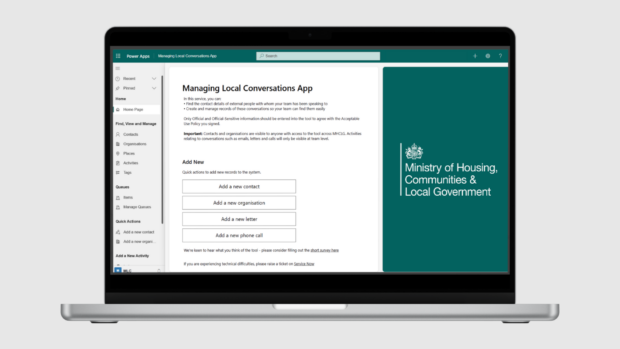 The homepage of the Managing Local Conversations service.
MLC is a shared service for recording and understanding external engagement. It gives policy, delivery, sponsorship and engagement teams a single place to log contacts and conversations.
By bringing information together, MLC helps teams to:
see existing relationships before starting new conversations reuse insight instead of starting from scratch build continuity over time treat engagement insight as organisational knowledge, not personal notesMLC is not about changing why teams engage, it’s about making existing conversations visible, reusable and more valuable.
Our work also supports the efficient adoption of AI tools in our department, which, as we know, rely on accessible, consistent and quality data and processes to deliver their full value.
Our vision is for MLC to be:
“a single service for all teams to manage their external contacts and conversations, enabling collaborative and modern ways of working for a data-driven MHCLG”
MLC provides a single, department-wide contact book that brings engagement information into one place. Teams can filter and view data in ways that make sense for their work, using tags to record insight consistently. Conversations can be imported directly from Outlook, reducing manual effort, and built‑in Copilot support helps users to find and summarise past interactions, with privacy and compliance designed in.
“For a busy digital transformation programme with local government and other stakeholders like ours, co-ordination is essential to make sure our projects and resources are deployed most effectively and efficiently. Managing Local Conversations is helping our programme to spend less time making and updating contact lists manually or sharing intel verbally and more time strengthening the relationships we need to enable the delivery of 1.5m homes.” – Digital Planning team, MHCLG
“MLC has allowed me to easily and quickly record readouts from meetings, store important documents, and list important contacts quickly and easily, helping myself and the team to manage important information on Pride in Place Programme neighbourhoods in a clear and consistent manner. This has meant that seniors have been able to quickly access information on places and has ensured institutional memory of what has happened in a place – this will be crucial to the success of a programme that spans 10 years.” – Charles Farrer, Pride in Place Programme, MHCLG
Why we built MLC ourselves
We looked at existing tools, but none met our needs without significant compromise. Most would have added another system alongside those already in use, rather than reducing duplication. Building MLC in-house allowed us to design a service around real user needs, while avoiding a growing landscape of slightly different but largely similar systems across the department.
Owning the service also means we can move quickly. We can respond directly to user feedback, make changes as needs evolve, and improve the service without relying on lengthy procurement cycles. This helps us deliver value sooner and keep the service aligned with how teams actually work.
Building MLC ourselves has also proved better value for money. By consolidating tools and avoiding multiple licences and support contracts, we reduce ongoing costs and deliver efficiencies for the department.
From the start, we designed MLC to scale. It's built on Power Platform as a model-driven Power App-based solution, with a Microsoft Dataverse database - allowing the service to grow as more teams join while remaining stable and secure. Using the Microsoft platform also makes it easier to integrate with other corporate systems and the Microsoft 365 suite and simplifies assurance processes such as cyber security and data protection by relying on well‑understood, compliant technology.
How we’ve been building the platform
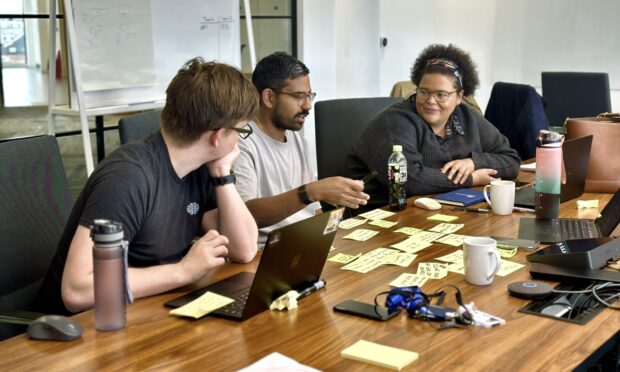
We’ve been building MLC in line with the GOV.UK Service Standard as well as the objectives and principles of MHCLG’s Digital Strategy:
We work in agile ways, releasing improvements regularly and learning from each iteration. Security, accessibility and compliance are built in from the outset. We start with user needs. Continuous user research shapes what we build and what we prioritise next, ensuring the service focuses on real problems rather than assumptions. We also design for fairness and access. MLC provides a shared platform that works for teams of different sizes and functions, reducing reliance on local tools or personal systems. Finally, we plan for change. MLC is designed to evolve, with a roadmap shaped by ongoing research, feedback and changing organisational priorities.What’s next
We’re continuing to improve MLC based on user feedback. We’ve already introduced the ability to send bulk emails, thus reducing manual effort, and next we’re looking to integrate with GOV.UK Notify, which will further user ability to send mass communications.
We’re also improving onboarding and training to help teams get value sooner, alongside clearer dashboards and reporting to make engagement insight easier to understand and act on.
Want to know more?
While MLC was built in MHCLG, the challenge it addresses is shared across government.
We hope our learnings are useful to others thinking about how to manage engagement insight more effectively, and we’re keen to learn from you too. If you’ve built something similar in your organisation, we’d love to hear what’s worked, and what hasn’t:
Get in touch with our team at
We’ll continue to share our progress on the blog, including what we’re learning from users and how we’re balancing agile delivery with supporting a live service.