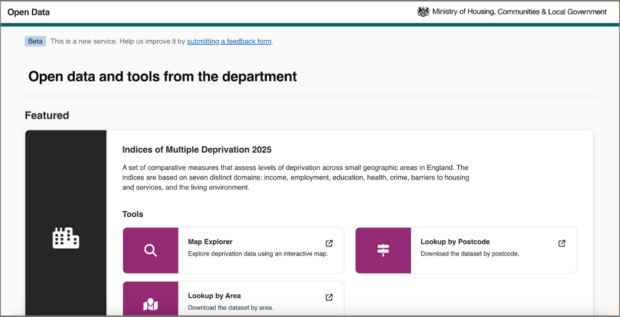
 A screenshot of the homepage of the new Open Data Communities platform
Open data plays a vital role in supporting transparency, accountability and innovation across the public sector. By making data openly available, we inform better decision-making, help develop new services, and support analysts, researchers, journalists and others to better understand their areas.
That’s why 12 years ago, we established Open Data Communities (ODC) – the platform for the Ministry of Housing, Communities and Local Government (MHCLG) to routinely release its data outputs in fully open, accessible and reusable forms.
But today, ODC is changing. This blog post talks about how it’s evolving and why.
What exactly is Open Data Communities?
ODC is comprised of 3 main features:
Indices of Multiple Deprivation tools Energy Performance Certificates (EPC) open data and API Linked Data Mart (powered by PublishMyData)Open Data Communities is now evolving to reflect how users today access and use open data, and to prepare the ground for future opportunities.
What is changing?
Here’s what’s changing in ODC and why.
New look and a new URL
When work is complete, https://opendatacommunities.org/ will redirect users to https://open-data.communities.gov.uk/, a new purpose-built platform hosted on MHCLG-owned, robust and scalable cloud infrastructure.
New datasets in machine-readable format
We will begin by publishing one of our most popular datasets – the Indices of Multiple Deprivation – as CSV on the Web (CSVW). Publishing data in CSVW is part of our commitment to using open web standards, ensuring MHCLG data is consistent and linkable across government. The government guidance on open standards states that:
“By using CSVW, we can:
more easily process CSVs into an annotated data model make CSVs easy to share and collaborate on make CSVs machine-readable”New service: Get Energy Performance Data
EPC data – information that shows how energy efficient a building is – is another popular offering from the department. The EPC register team will now take ownership of EPC open data and build a new service. The service will have an improved user experience alongside reliable, quality data. This change reflects the value and importance of EPC data across both the public, private and third sectors. The team is working to build, test and deploy the new service, and in the interim, we will continue to signpost users to the existing tool from our new homepage.
Linked Data Mart to be deprecated
The Linked Data Mart (PublishMyData) is being retired. Linked Data Mart was a platform that focused on linked data and semantic querying, aimed primarily at users comfortable with specialist data tooling. After much research and evaluation, we identified that it was no longer providing the value for money and quality data required by our users. Interviews with users and analysis of usage statistics showed us that very few users used the specialist linked data tooling, preferring instead to download raw data to transform and analyse elsewhere such as with Power BI.
Why are we making these changes now?
Over the last 12 years, our users and their needs have changed significantly. Our user base now includes open data specialists, public sector analysts, private sector data consumers, academics, journalists and much more – all with different levels of technical expertise and methods for using data.
Through our user research and an impact assessment, we found a clear preference for simple, accessible formats that can be used at scale without specialist tools. New tools, such as Power BI, allow users to transform and present data into compelling reports and dashboards.
New initiatives, notably MHCLG’s Digital Planning Programme, are demonstrating how standardised data will underpin more efficient and effective services. Arguably, the rapid growth of AI will inevitably fuel demand and opportunities for data to be re-used in ways we cannot predict or imagine.
Prioritising providing simpler formats lets us make a stronger case for value for money. We want to focus resources on formats that are accessible for the widest possible range of users and meet modern open data standards. By building a sustainable foundation, we create an opening for the future development of new features, where there’s a clear user need.
We don’t see this as an end, but a deliberate new beginning. We are taking a user-led approach to open data within the department, with a hope that Open Data Communities can evolve in response to real demand.
When are these changes happening?
The Analytical Data as a Service team is hard at work ensuring a smooth transition, and we anticipate these changes being completed by the end of March 2026. Once the redirection and new datasets are live, we’ll share another blog post walking through the changes.
Let us know what you think
We’re excited about the future of the department’s open data offering. We would love to hear your feedback on these changes and any other features of Open Data Communities. Contact us at: